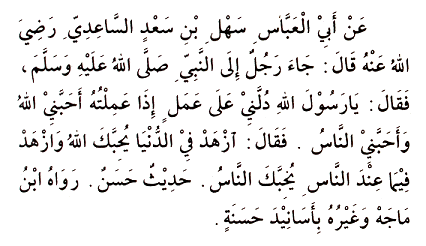
On the
authority of Abu al-'Abbas Sahl bin Sa'd al-Sa'idi, radiyallahu 'anhu,
who said:
A man came to the Prophet, sallallahu 'alayhi wasallam,
and said: "O Messenger of Allah, direct me to an act which if I do it, [will
cause] Allah to love me and people to love me." He, sallallahu 'alayhi
wasallam, answered: "Be indifferent to the world and Allah will
love you; be indifferent to what people possess and they will love
you."
[A fine
hadith related by Ibn Majah and others with good chains of
authorities]
background
This
hadith is a weak hadith as pointed out by many scholars. Ibn Rajab gave a
detailed argument about the weakness of this hadith. However, later
scholars still recorded their commentaries on the text of the hadith for
several reasons. The major two reasons are:
- Sometimes the chain of the narrators (sanad) is not strong and the
hadith consequently is not an authentic hadith. But the meaning of
the text of the hadith is correct and acceptable. In this case the
scholars still give their comments on the hadith.
- The hadith is
related to one of the major concepts in Islam which is al-zuhd.
Unfortunately, many
Muslims misunderstand and misinterpret this concept due to the influence of other
cultures. We need to remove this misunderstanding or misinterpretation which is
linked to this concept.

Ibn Rajab says that this
hadith contains some great advice:
- Prophet Muhammad, sallallahu 'alayhi wasallam, said the renouncing of
this world will lead to the love of Allah. In other words, the one who practices
this zuhd will be loved by Allah.
- To renounce what people possess and that will cause the love of people to
the person who practices zuhd. Al-zuhd has been emphasized in the
Qur'an and hadiths especially zuhd in this world. In Surah
al-Nisa' Ayah 77, Allah says:
Brief is the enjoyment of this world whereas the life to come is
best for all who are muttaqun or conscious of Allah.
In Surah al-Ra'd Ayah 20, Allah says:
The life of this world is nothing but a flitting
pleasure.
In Surat al-A'la Ayah 16-17, Allah says:
But may you prefer the life of this world although the life to come
is better and more enduring.
In Sahih Muslim, on the authority of Jaber Ibn 'Abdullah, radiyallahu
'anhu, that the Prophet, sallallahu 'alayhi wasallam, one day was
passing through the market and he passed by a dead goat, which had its ears cut.
He held the goat by the ear and asked who would like to have it for one derham
(which was a very low price of currency at that time). The people said they
wouldn't take it even if it was free. What could they do with it? He,
sallallahu 'alayhi wasallam, asked if they liked it if it was theirs.
They said even if it was alive they would still not buy it because of its cut
ears. So how could they buy it now especialy since it was dead. The Prophet,
sallallahu 'alayhi wasallam, said: "This worldly life is so little in the
sight of Allah as this dead animal or goat is so little in your
sight".
- There are many other hadiths where the Prophet, sallallahu 'alayhi
wasallam, commanded Muslims to avoid asking others for anything, especially
money, and to do the best not to indulge in the act of asking others.
lessons
One of the early scholars,
Abu Muslim Al-Hawlani, says zuhd in this world does not mean forbidding
what is permissible or wasting wealth. Zuhd with respect to this world is
only where a person puts more trust in Allah, more than what was is in his own
hands. If he was afflicted with calamity by losing something of this world, he
is more hopeful for its reward and what is in store for him in the Hereafter
than if it were to have remained with him.
Based on this, Ibn Rajab
states that zuhd can be interpreted as three actions of the
heart:
- The Muslim should realize that all provisions come from Allah and not simply
the result of his own acts. He should trust Allah and what Allah has more than
what he has in his hands.
- If he loses anything in this world, this should not bother him because he is
looking for its reward.
- The Muslim should not care whether he is going to be blamed or praised by
others. He will not look for praise. In his heart, he is not touched by such
praise. And if he is blamed, he will not be offended by being blamed. If the
accusation is not true, he has nothing to worry about; if it is true then he has
to face it and try to be a better Muslim.
We can also try to see and
compare what was narrated by Al-Imam Abu Muslim Al-Hawlani and what has been
narrated by other scholars. Al-Imam Ahmad bin Hanbal was asked one day if
someone owns one thousand dinar, can he still be a zahid? He replied yes,
he can be still a zahid if he does not feel rejoice if the money increases and
he does not become sad if it decreases. We must not become slaves to money or
our worldly possessions. We can be wealthy and zahid if we are still
thankful to Allah and use wealth in the right way (provided also that we
obtained this wealth in the right way). This meaning has been emphasised by
Sufian Ibn 'Uyainah, one of the great scholars, when he was asked who is to be
considered as zahid. He said whoever Allah bestowed a bounty on him then
he is thankful and then when he is under trial, he is patient.
Sufian Al-Thawri - another
scholar - said: Al-zuhd in this world is that you are ready in your heart
and think of the Hereafter - you think of death. We should be prepared for the
next world. This is a definition of zuhd. Zuhd means a status of
the heart where a person fears he will not live a long life. This will motivate
every one to be a good Muslim. If we have this feeling that we are going to
leave this world at any time, this will lead us to be closer to Allah and
fulfill our obligations and also to get away from disobedience.
This is why some scholars
point out that there are different types of zuhd:
- Al-zuhd in disobedience and sin
- Not to be misled by our desires.
- Not to exceed the limits of
the permissible or the allowable acts (mubah). For example, we should not
exceed the limits of sleeping (i.e. sleeping unnecessarily long hours) or eating
(i.e. eating too much) which is permissible.
Ibn Rajab said the one who
is hopeless of living a long life, then he is looking forward to meeting Allah
and he is eager for the Hereafter - this is the maximum level of zuhd.
Ibn Rajab then says that looking at this worldly life as blameworthy is not
because of the day or night, which are signs of Allah, and not the place and not
what He planted in the land, or the animals He created. All of these are
bounties from Allah and beneficial to us. The blameworthy is actually with
regards to the actions of the people in this life because most of these actions
are not done in accordance to the guidance of revelation in a way that will lead
to good consequences. Usually the consequences will be bad ones. People will not
be able to do good things.
What should be done then is
to be like the righteous and good people who used their lives as a means of
getting them to the final destination. They were satisfied and contented by
whatever they got. Even permissible acts and desires are treated in the same
way. Sleeping and eating are good for us because this will help us to perform
our obligations. That is why Ibn Rajab says all the early scholars looked for
these permissible actions as means of fulfilling their obligations. He quoted
al-Hasan al-Basri who said: Doing whatever is beneficial for you is not
considered as the love of this world. So we should not belittle some professions
and consider them as part of worldly life.
Some Muslims misunderstand
zuhd. This will lead the Muslim community to become backward. Since we
are entrusted for the establishment of Islamic civilization, this requires that
we have professionals, and different fields of specializations. All these take
effort and time. But what we do here is for the betterment of the community
where there is a great need for professional people. If we do it with good
intentions and for the sake of Allah we will be rewarded - this is the real
zuhd.
Zuhd does not mean
that we stay in one place and worship Allah. Worshiping Allah is a broad
concept. The betterment of the community is considered as a form of worship. So
asceticism or zuhd does not clash with any of the worldly affairs that
the community needs. The zuhd here becomes that we do it in the right
way, with a good intention and for the sake of Allah. This should not keep us
from fulfilling the obligations towards Allah.
Ibn Rajab mentions that the
worldly life is cursed because it keeps people away from Allah. They will be
deprived from fulfilling the obligations. This life is a test for us, as stated
in Surah al-Kahf Ayah 7. We either use it in the right way and be rewarded or we use it in the wrong
way which will cause us to fail the test - we will go astray and indulge in
disobedience.
conclusion
One thing that
brings us closer to Allah and to be loved by Him is al-zuhd. There are
other actions that make Allah love us:
- To love Allah much. If we love Allah, He will love us.
- The love of meeting Allah (as stated in another hadith).
- The love of the Prophet, sallallah 'alayhi wasallam, more than we
love ourselves and our family and to love his sunnah and to follow his model.
- Remembrance of Allah, and all forms of dzikr.
- To practice the preferable good deeds.
If we claim that we love
Allah, we should test ourselves by taking the above points as criteria. By
loving Allah, we will be successful in this life and the Hereafter.
 ICTruth.info